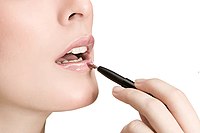
Lip gloss being applied with a retractable lip brush.
Lip gloss is a product used primarily to give lips a glossy lustre, and sometimes to add a subtle color. It is distributed as a liquid or a soft solid (not to be confused with lip balm, which generally has medical or soothing purposes) or lipstick, which generally is a solid, cream like substance that gives off a more pigmented color. The product is available in ranges of opacity from translucent to solid, and can have various frosted, glittery, glossy, and metallic finishes.
Like lipstick, lip gloss comes in a variety of forms and may be applied in different ways. It can be contained in a small cylinder and applied with a rounded or sloped applicator wand (known as a doefoot applicator) or with a built in lip brush. It can come in a small, soft, squeezable plastic tube designed to be passed over the lips or applied with a fingertip or lip brush. Solid or semisolid glosses come in boxes or tubes and sometimes blur the distinction between lip gloss and lip balm.
Basic lip gloss adds basic shine to the lips without color. Colored lip gloss adds a combination of color and shine. Glittery lip gloss can be with or without color, but has a glitter base.
New types of "plumping" lip gloss contain ingredients that make the lips appear softer and plumper. These are a cheap, easy, and usually harmless alternative if compared to collagen, Restylane, Juvederm, or fat injections. They are not as effective, however because the effects are temporary.
Lip gloss is often used when a person wants to have some color on their lips, but does not want an intense, solid lip color effect (i.e., a more "made-up" look), as lipstick would create. Lip gloss is also often used as an introduction to makeup. It is often used by preteen and young teenage girls who want to wear some makeup, but are too young to wear more intense lipstick colors. Lip gloss is also common for young women who don't like to wear makeup but have to attend a formal occasion. Lip gloss can be applied on top of lipstick to increase the gloss of a color, or to add depth as in the case of glitter gloss.

The word perfume derives from the Latin perfume, meaning "to smoke through". Perfumery, as the art of making perfumes, began in ancient Mesopotamia and Egypt and was further refined by the Romans and Persians.The world's first recorded chemist is considered a woman named Tapputi, a perfume maker mentioned in a cuneiform tablet from the 2nd millennium BC in Mesopotamia.[2] She distilled flowers, oil, and calamus with other aromatics, then filtered and put them back in the still several times.[3]In India, perfume and perfumery existed in the Indus civilization (3300 BC – 1300 BC). One of the earliest distillations of Ittar was mentioned in the Hindu Ayurvedic text Charaka Samhita and Sushruta Samhita.[4]In 2003,[5] archaeologists uncovered what is believed[by whom?] to be the world's oldest surviving perfumes in Pyrgos, Cyprus. The perfumes date back more than 4,000 years. They were discovered in an ancient perfumery, a 300-square-meter (3,230 sq ft) factory[5] housing at least 60 stills, mixing bowls, funnels, and perfume bottles. In ancient times people used herbs and spices, such as almond, coriander, myrtle, conifer resin, and bergamot, as well as flowers.[6] In May 2018, an ancient perfume “Rodo” (Rose) was recreated for the Greek National Archaeological Museum's anniversary show “Countless Aspects of Beauty”, allowing visitors to approach antiquity through their olfaction receptors.[7] Etruscan perfume vase shaped like a female head, 2nd century BCE the 9th century the Arab chemist Al-Kindi (Alkindus) wrote the Book of the Chemistry of Perfume and Distillations, which contained more than a hundred recipes for fragrant oils, salves, aromatic waters, and substitutes or imitations of costly drugs. The book also described 107 methods and recipes for perfume-making and perfume-making equipment, such as the alembic (which still bears its Arabic name.[8][9] [from Greek ἄμβιξ, "cup", "beaker"][10][11] described by Synesius in the 4th century[12]).The Persian chemist Ibn Sina (also known as Avicenna) introduced the process of extracting oils from flowers by means of distillation, the procedure most commonly used today. He first experimented with the rose. Until his discovery, liquid perfumes consisted of mixtures of oil and crushed herbs or petals, which made a strong blend. Rose water was more delicate, and immediately became popular. Both the raw ingredients and the distillation technology significantly influenced western perfumery and scientific developments, particularly chemistry.The art of perfumery was known in western Europe from 1221, taking into account the monks' recipes of Santa Maria delle Vigne or Santa Maria Novella of Florence, Italy.[citation needed] In the east, the Hungarians produced in 1370 a perfume made of scented oils blended in an alcohol solution – best known as Hungary Water – at the behest of Queen Elizabeth of Hungary. The art of perfumery prospered in Renaissance Italy, and in the 16th century the personal perfumer to Catherine de' Medici (1519–1589), Rene the Florentine (Renato il fiorentino), took Italian refinements to France. His laboratory was connected with her apartments by a secret passageway, so that no formulae could be stolen en route. Thanks to Rene, France quickly became one of the European centers of perfume and cosmetics manufacture. Cultivation of flowers for their perfume essence, which had begun in the 14th century, grew into a major industry in the south of France.Between the 16th and 17th centuries, perfumes were used primarily by the wealthy to mask body odors resulting from infrequent bathing. Partly due to this patronage, the perfume industry developed. In 1693, Italian barber Giovanni Paolo Feminis created a perfume water called Aqua Admirabilis,[13] today best known as eau de cologne; his nephew Johann Maria Farina (Giovanni Maria Farina) took over the business in 1732.[14][need quotation to verify]By the 18th century the Grasse region of France, Sicily, and Calabria (in Italy) were growing aromatic plants to provide the growing perfume industry with raw materials. Even today, Italy and France remain the center of European perfume design and trade.
Colorbar Ever Sharp Lip Liner Miss Cheat Review
Hi ladies!I am excited to write today, because I completed over 50 reviews on IMBB. I hope this grows into even 1000 (ha ha). Thank you IMBB for channeling my obsession in some direction. It may not be a life changing thing, but it is one of the most important parts of my life now, to write here and share my thoughts. With this small thank you to IMBB, I would like to move ahead. Along with Colorbar kiss proof lipstick– oh tempt me, I also purchased their ever sharp lip liner in the shade “Mist Cheat”. As always, I will tell you what made me buy this in an impulse: “ever sharp” and “transparent” shade. Yes! This liner claims to be an ever sharp and transparent shade, making it even more interesting to use. Product Description:
Leave a trace of seduction with every glide along the contours of your lips! With texture luxuriously creamy, this waterproof, no-feathering, no-transfering liner provides a surge of long lasting, semi matte vibrant color that will make your lips look irresistible! How to Use:
Extra precise, Extremely soft, Highly pigmented, Rich colour pay-off, Full coverage. Price:
INR 675 for 0.25gmMy Experience with Colorbar Ever Sharp Lip Liner Miss Cheat:The packaging screams itself to be of Colorbar in a silver box and black text. The pencil is black with screw cap, but doesn’t click and this is where the magic happens. When we close the cap, with the screw process it sharpens the tip again. So, next time when we unscrew to open, we again get to see pointy tip. Smart thought there. It’s a good quality plastic and looks sturdy. However, I will still not advice to travel with this, without putting it in a box. Because, no matter how good they are, the pencils are relatively fragile. I am sure the cap will not open because of the screw mechanism.
 There is no smell at all. It is a transparent shade, therefore cheat me. It is creamier compared to wooden pencils.
Now, we come to actual action of the product. This absolutely does nothing except making the cream lispticks look semi-matte. That’s it. It doesn’t act as primer. It cannot be used to conceal outlines, as it is zero coverage. When you apply on lips as a lipstick base, it just makes the lips little smooth and mattifies the lipstick. It is transparent, so when you try to swatch, camera picks up nothing. In real, it has slight blurring affect.
 Another annoying fact about this product is that you cannot twist it out! Yes! The tip is close to the black end and it cannot be twisted out more. It get sharpened automatically with this tiny height when you close. So, in case if you have used out the exposed product and you need to take out more, you actually have to lock the pencil and unlock it again. Weird!
 Pros of Colorbar Ever Sharp Lip Liner Miss Cheat:Nice new concept of auto sharpening.Good packaging.Cons of Colorbar Ever Sharp Lip Liner Miss Cheat:Pricey.Annoying that you cannot take out more product.Does nothing.Nowhere on the website they have mentioned, what is the exact purpose of this transparent lip liner
 Season after season, we look to the runways of Fashion Week to hunt down the latest beauty trends and must-have products, and while some seasons may be more note-worthy than others (ahem, the Alexander Wang side braid of Spring 2010 or the wet hair trend of Fall 2013), there’s always something exciting to be uncovered if you know where to look.Backstage, for example, there is a lot going on where beauty brands are concerned—and we’re not just talking about the runway looks. Brands like MAC Cosmetics, for example, use Fashion Week as an opportunity to test-drive all their new products before they hit the shelves. For a brand like MAC that works so hand-in-hand with their professional makeup artists, Fashion Week offers the ultimate road test—a moment to put any new product through the grind, with MAC artists as the ultimate feedback loop, operating at their busiest time of year. Why is this such an opportunity for the brand? Considering MAC is a makeup artist brand through-and-through, having their global artists as a staple in their testing process (and giving them the ability to have such a voice and collaboration in the development model) reinforces the ethos of the brand – all ages, all races, all sexes. So what’s MAC testing this year? We got the scoop.


